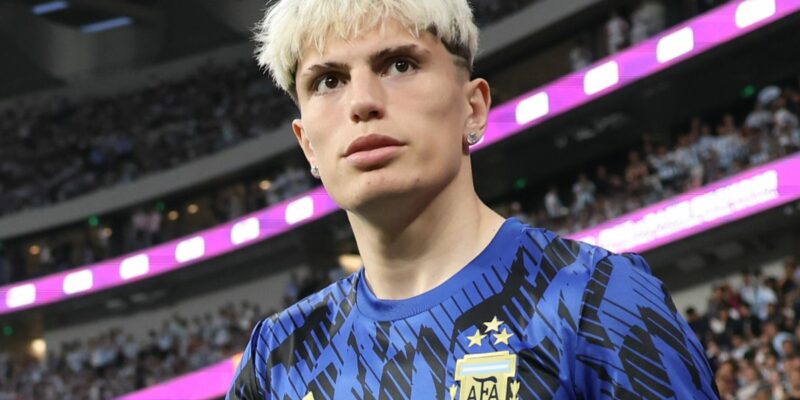
The winger was once viewed as one of the brightest young talents in the national team setup, but his journey toward the tournament took an unexpected turn. Alejandro Garnacho’s absence from Argentina’s 2026 World Cup squad has become one of the biggest talking points surrounding the defending champions. The winger was once viewed as one of the brightest young talents in the national team setup, but his journey toward the tournament took an unexpected turn.
Argentina enters the 2026 World Cup as one of the strongest teams in the competition after an outstanding qualifying campaign. The national team dominated the South American qualifiers, collecting 38 points from 18 matches and finishing comfortably ahead of its rivals.
The campaign still had moments of concern, with four defeats and some unexpected results raising questions among supporters. However, Argentina also showed its championship mentality by defeating Brazil twice, including a spectacular 4-1 victory at the Monumental that highlighted the quality of Lionel Scaloni’s squad.
The coach has since suggested that repeating the success of 2022 will be difficult. Argentina still has many players from the Qatar-winning squad, but the team is entering a new stage with Lionel Messi approaching his 39th birthday and Angel Di Maria no longer part of the national setup.
Angel Di Maria, Lionel Messi and Nicolas Otamendi of Argentina celebrate.
The real reason Alejandro Garnacho was left out
The decision to exclude Garnacho from Argentina’s World Cup squad was ultimately a tactical choice made by Scaloni and his coaching staff. The 21-year-old winger was included in the preliminary squad but failed to make the final list after the manager decided that other players better matched the team’s current needs.
According to beIN SPORTS, one of the biggest concerns was Garnacho’s ability to follow Argentina’s tactical instructions. During previous opportunities with the national team, the coaching staff reportedly wanted him to be more aggressive, attack defenders directly, and create danger in one-on-one situations.
Alejandro Garnacho of Argentina leaves the pitch in a substitution
However, Scaloni’s staff felt that the Chelsea ace sometimes played too safely, choosing simpler passes instead of taking the risks expected from a player with his explosive qualities. In a team built around collective discipline and tactical responsibility, that became a major factor.
The winger’s lack of recent involvement with Argentina also worked against him. Garnacho had not played for the national team for more than 18 months before the World Cup squad was announced, leaving him behind competitors who had become more integrated into Scaloni’s plans.
Chelsea move did not produce the expected breakthrough
Garnacho’s move from rivals Manchester United to Chelsea was supposed to be a turning point in his career. The transfer was viewed as an opportunity for the young attacker to take on more responsibility, play regularly, and strengthen his case for Argentina.
However, the move did not completely transform his situation. While he made 43 appearances across all competitions and recorded eight goals and four assists, he struggled to become an undisputed starter.
Alejandro Garnacho of Chelsea celebrates
For Scaloni, club form matters, especially when choosing players for a tournament where every role must be clearly defined. Garnacho showed flashes of his talent, but consistency was missing at a time when Argentina had intense competition for attacking positions.
Argentina’s attack leaves little room for mistakes
The competition for places in Argentina’s forward line is extremely difficult. Lionel Messi remains the team’s leader, while players such as Lautaro Martinez and Julian Alvarez continue to provide elite attacking options.
Alejandro Garnacho of Argentina looks on
The national team has also seen younger players rise quickly, with Nico Paz becoming one of the most exciting names after a strong season in Italy. Paz has earned praise from Messi himself and represents the next generation that Scaloni wants to develop.
Argentina also has players capable of offering a range of qualities, including Thiago Almada, who is expected to take on a bigger role after Di Maria’s retirement. With so many options available, Garnacho’s previous status as a promising talent was no longer enough to guarantee his place.