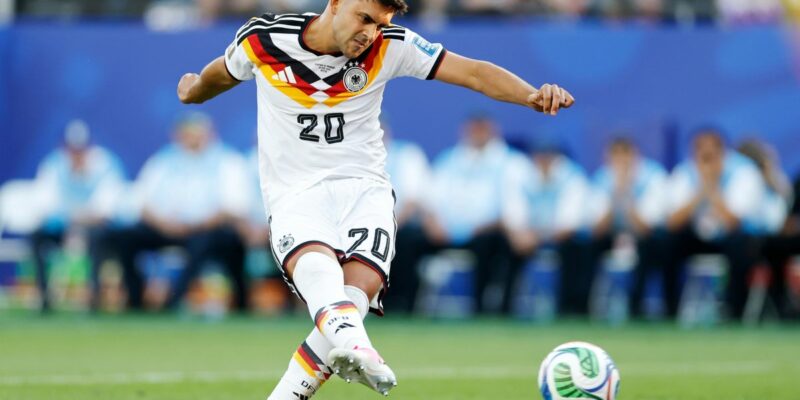
Penalty shootouts are becoming a regular presence during the 2026 World Cup knockout stage, and function as the match’s tiebreaker. When a World Cup knockout match is still tied after 90 minutes of regulation and 30 minutes of extra time, the result comes down to a penalty shootout. Each team selects five players to take an initial round of kicks, alternating turns from the penalty spot.
The shootout doesn’t always go the full five rounds. If one side builds a lead the other team mathematically cannot overcome — even with all of its remaining attempts — the shootout ends immediately. That’s how, in the 2022 final, Argentina’s win was sealed after their fourth penalty, even though both teams technically had one kick left.
If the teams are still level after all five initial kicks have been taken, the shootout moves into sudden death. From that point on, each side takes one penalty per round, and the shootout ends as soon as one team scores and the other misses in the same round.
There’s no cap on how many sudden-death rounds can be played — if every eligible outfield player and goalkeeper has already taken a kick and the score is still tied, the order resets and the cycle continues until a winner emerges.
Ismael Saibari of Morocco scores the team’s fifth and winning penalty vs the Netherlands. (Getty Images)
Before any of this begins, the referee runs through a couple of formalities. Two coin tosses decide which team kicks first and which end of the field the shootout will be taken at, since both teams take all of their penalties at the same goal.
The rules goalkeepers and kickers have to follow
Goalkeepers face strict limits during a shootout. They must stay on the goal line, though they’re allowed to move side to side along the line. They can take one step forward at the moment of the shot, but they must keep at least one foot on the line.
Stepping forward off the line before contact, touching the woodwork as a distraction, or trying to put off the kicker verbally can all result in the kick being retaken if it’s missed.
Kickers have their own restrictions, too. The ball must be struck cleanly — if a player makes contact with it more than once during their attempt, the kick is disallowed if scored, or recorded as a miss if it wasn’t.