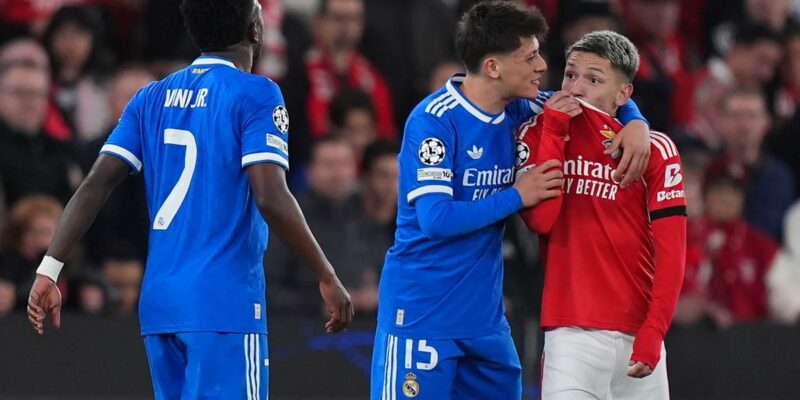
What initially appeared to be a disciplinary matter within European competition has evolved into something far more significant for both club and country. The fallout from a heated Champions League night continues to ripple through the game, with Gianluca Prestianni and Vinicius Junior at the center of a controversy that has now reached the global stage. What initially appeared to be a disciplinary matter within European competition has evolved into something far more significant for both club and country.
The controversy began during a Champions League fixture on 17 February, when Prestianni was accused of using homophobic language toward Vinicius Junior. The confrontation escalated after Vinicius scored, with reports stating the Benfica player covered his mouth while speaking to the Brazilian forward.
UEFA later confirmed the punishment, stating that Prestianni had admitted to “homophobic conduct”, while a separate allegation of racial abuse was not proven after investigation. The match briefly halted as the referee activated anti-discrimination protocols, highlighting the seriousness of the situation.
UEFA’s Control, Ethics and Disciplinary Body handed down a six-match suspension on 24 April, with a portion of the ban suspended for two years. One match was already served during the second leg of the tie, while the remaining games were distributed across European competitions.
@tntsports pic.twitter.com/Fp4yhjWbg9— ‘ (@YrcQo) February 18, 2026
A UEFA regulation cited in the case states that discriminatory behavior can lead to “a suspension lasting at least ten matches or a specified period of time”, underlining the severity of such offences. However, Prestianni’s sanction was set at six matches after the final ruling, with mitigating factors considered during the process.
FIFA steps in and expands the ban
The case took a major turn when FIFA accepted UEFA’s request to extend the suspension worldwide. This decision means the punishment now applies beyond club soccer and into official international competitions, including the World Cup.
“The FIFA Disciplinary Committee has decided to extend the six-match ban imposed by UEFA on SL Benfica player Gianluca Prestianni to have worldwide effect,” a FIFA spokesperson confirmed. The sanction is based on Article 70 of the FIFA Disciplinary Code, ensuring consistency across global competitions.
Vinicius Junior of Real Madrid is challenged by Gianluca Prestianni of SL Benfica.
What it means for the World Cup
The global extension of the ban directly affects Argentina’s tournament plans, as Prestianni would miss the national team’s opening two World Cup matches if selected. Argentina, a national team with strong depth in attacking positions, now faces uncertainty over whether the winger will be included at all.
He has only one senior cap for La Albiceleste, which makes his selection increasingly unlikely despite earlier call-ups during friendly matches. Thus, the combination of limited international experience and a suspension affecting major fixtures places his World Cup hopes in serious doubt. Coaches often prioritize availability and reliability in tournament selections, especially in high-pressure environments.
ianluca Prestianni of Benfica speaks towards Vinicius Junior of Real Madrid
In response to similar situations, FIFA has moved quickly to tighten regulations. A proposal aimed at discouraging players from hiding their speech during confrontations has now been approved at the highest level of the sport’s rulemaking body.
The International Football Association Board has given competitions the authority to issue a red card to players who cover their mouths while insulting opponents, marking a significant shift in how such incidents are handled. The timing of this decision has only intensified the spotlight on Prestianni’s case.