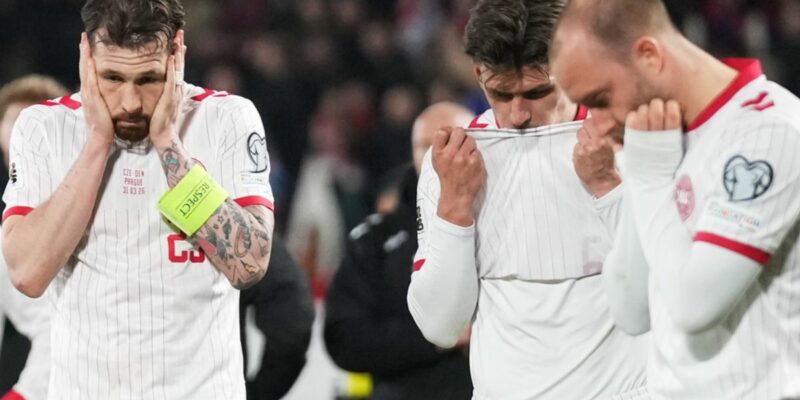
Denmark have managed to build a roster full of talent, with several of their players excelling in Europe. Despite this, head coach Brian Riemer failed to lead the national team to the 2026 World Cup, ending a streak of two consecutive qualifications. Basing their sporting project on young talent, Denmark have managed to establish a highly promising setup. Not only has Rasmus Højlund excelled at the highest level, but so have Mikkel Damsgaard, Patrick Dorgu, and others. Despite this star-studded roster, head coach Brian Riemer failed to lead the national team to the 2026 World Cup. As a result, they have seen their streak of two consecutive tournaments qualifications come to an end.
After finishing second in Group C of the UEFA Qualifiers, they faced the Czech Republic in the playoff final, losing on penalties. While Højlund managed to score five goals across the matches, head coach Brian Riemer failed to establish defensive solidity, causing his side to trail on the scoreboard for much of the game.
Denmark qualified for the 2018 and 2022 World Cups. Therefore, failing to qualify for the 2026 edition, despite the expansion of available spots, represents a complete failure. Beyond Højlund and Mikkel Damsgaard, they also possess players such as Morten Hjulmand, Pierre-Emile Højbjerg, Joachim Andersen, Patrick Dorgu, and others who could have provided consistency in their play, but Brian Riemer failed to find the right path.
Rather than dismissing Brian Riemer, the Danish Soccer Association has decided to back the continuity of its project. With many young players in the squad, they are betting on their continued development and a return to the World Cup in 2030. However, their performance at UEFA Euro 2028 could determine the next steps of the project.
Rasmus Hojlund of Denmark runs with the ball under pressure from Stepan Chaloupek of Czechia.
How many times have Denmark played in the World Cup?
Denmark have not managed to become a dominant force in UEFA competitions, with their most recent major titles being UEFA Euro 1992 and the 1995 Confederations Cup. However, they have been regular participants at the World Cup, appearing in six editions. Since the 2002 tournament, they have qualified for four of the last six editions, highlighting their status as a competitive national team.
Despite being frequent World Cup participants, they have not consistently emerged as true contenders. Their best performance came in the 1998 edition, when they reached the quarterfinals. Since then, they have advanced to the Round of 16 on four occasions and exited in the group stage in two editions.