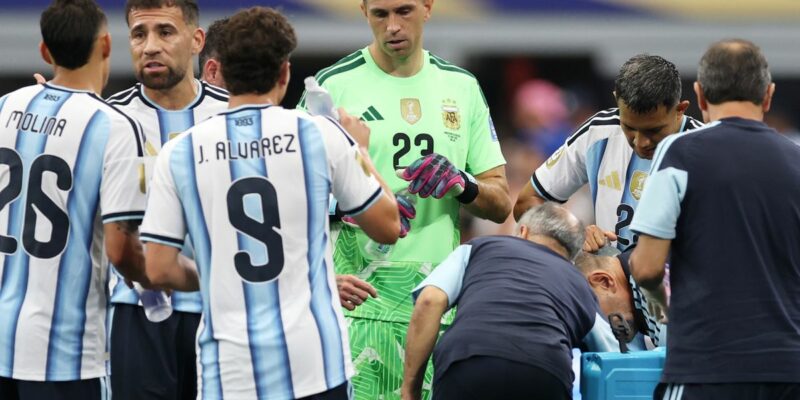
The debate surrounding mandatory hydration breaks has intensified throughout the tournament, with critics questioning whether the interruptions are truly about player welfare or whether commercial interests have become a driving force. UEFA has finally revealed its position on one of the most controversial innovations of the 2026 World Cup, offering clarity on what supporters, players, and clubs can expect at Euro 2028 and future Champions League matches. The debate surrounding mandatory hydration breaks has intensified throughout the tournament, with critics questioning whether the interruptions are truly about player welfare or whether commercial interests have become a driving force.
The issue has attracted widespread attention after broadcasters were estimated to generate around $250 million in additional advertising revenue in the United States alone through the extra stoppages. While FIFA has defended its policy, UEFA has now made its own stance clear ahead of its upcoming competitions, ending weeks of speculation.
World Cup breaks sparked widespread criticism
The mandatory stoppages have become one of the biggest talking points of the tournament. Supporters have repeatedly booed referees after play was halted in matches played inside air-conditioned stadiums or in relatively mild temperatures, questioning why identical rules were applied regardless of the conditions.
England’s meeting with Croatia at AT&T Stadium, a climate-controlled venue, produced one of the clearest examples of fan frustration when spectators reacted negatively to the scheduled interruption despite the comfortable environment.
🚨JUST IN: Croatia and England fans are booing the hydration break pic.twitter.com/JFyzzZkbQ2— Polymarket Sports (@PolymarketSport) June 17, 2026
Several players and coaches have also questioned the policy. Netherlands captain Virgil van Dijk argued that hydration breaks should be assessed on a match-by-match basis, particularly when weather conditions do not present any significant risk.
Meanwhile, Uruguay manager Marcelo Bielsa said, “According to the general consensus, playing four periods instead of two alters the culturally constructed conception of how to interpret football. In my view, it adds nothing and takes away a lot.”
He added, “There are great successes, like the influence of VAR, which has improved the game, but this other attempt has consequences that are not positive. These aren’t just my opinions, but a general view.”
Virgil van Dijk says he’s not a fan of the mandatory hydration breaks introduced at the World Cup 🤔 pic.twitter.com/P5JcUEPcye— BBC Sport (@BBCSport) June 15, 2026
UEFA confirms its position on hydration breaks
UEFA has ruled out introducing FIFA-style mandatory hydration breaks for Euro 2028 and the Champions League. Instead, the governing body will continue using its existing policy, where cooling breaks are only introduced if weather conditions reach specific heat thresholds.
According to UEFA’s statement: “UEFA has no plans to change these regulations for upcoming competitions, including for the UEFA Champions League and UEFA 2028 European Championship.”
Jerome Opoku #18 of Ghana has a drink at the hydration break
The organization explained that match delegates already monitor conditions using a Wet Bulb Globe Temperature (WBGT) thermometer, with mandatory cooling breaks only required when temperatures exceed 32°C WBGT (approximately 35°C air temperature) for senior competitions. Below those limits, any drinks break remains entirely at the referee’s discretion.
The decision creates a clear distinction between UEFA’s approach and FIFA’s policy at the 2026 World Cup, where every match has featured two compulsory three-minute hydration breaks regardless of temperature or stadium conditions.
Commercial impact worth hundreds of millions as FIFA continues defends its policy
Much of the controversy has centered on the financial opportunities created by the mandatory stoppages. Broadcasters have been permitted to insert advertising during the three-minute breaks, creating valuable new commercial inventory during live matches. Industry experts estimate that Fox Sports alone could generate more than $250 million in advertising revenue in the United States.
General view at the hydration break at Atlanta Stadium
Meanwhile, worldwide revenue from hydration-break commercials could reach well beyond $1 billion across all broadcast markets, as per the BBC. Despite the criticism, FIFA has consistently maintained that the mandatory hydration breaks are designed solely to protect player welfare. The governing body has argued that applying identical rules across every fixture ensures fairness and competitive integrity throughout the tournament.
FIFA believes introducing breaks only in selected matches could create inconsistencies between teams playing under different conditions. As a result, the policy has remained in place throughout the competition, even in venues with retractable roofs and air-conditioning.